
Error in the code
You build a code and you run it in order to find the bugs. I’ve been skeptical for a few weeks as the Congressional model was not moving as I thought it should given changes in the environment. I was slow to touch it though, I did not want to introduce my biases.
This morning, however, I decided there had to be a problem, and there was. The generic D v R ballot polls were not updating, so that part of the math for each race had remained stagnate. When I fixed it this morning, a number of races in all the states appeared to change overnight. It was just, however, playing catch up with changes that should have been happening since August.
By noon today, everything should be up to date and reflecting a more up to date view of the races.
Another Amish Hotspot?
I’ve been busy recently building a projection model for the national measles case count dashboard and starting a class in Differential Equations and Linear Algebra. When I reviewed the national map of new cases, however, I could not help but notice a new source of cases in Eastern Illinois.
Douglas County IL reported four cases of measles in the last John Hopkins University update. Douglas County is also home to the first Amish community I observed as a child, a larger group colloquially referred to the Arthur Amish, owing to the community's concentration around Arthur, IL.
It is a more liberal expression of Amish ideals with many members of the community working outside of farming in woodworking and other industries. The Arthur Amish allow battery operated lights to be placed on their buggies for additional safety. Most relevant for the purposes of public health, however, while they have low baseline immunization rates, they have demonstrated cooperation with public health officials in the past during an outbreak of pertussis by participating in reactive vaccination.
Communication and Mass Vaccination Strategies After Pertussis Outbreak in Rural Amish Communities—Illinois, 2009-2010
Vaccination usage among an Old-Order Amish community in Illinois
Unfortunately, this research is dated. Attitudes towards vaccines have shifted in the last 15 years and I can claim no special knowledge of the current attitude makeup among the Arthur Amish.
More importantly, while I happened to be correct in may assessment that the Wisconsin outbreak was centered in the Amish community there, I'm still only guessing regarding this Illinois spark. More data should land soon.
Regardless, individuals and communities retain agency, even those with low vaccination rates. Reactive vaccination is better than no vaccination at all.
Cases Doubled in One Week
A week ago I offered a way to discern the communities most impacted by the southwestern Wisconsin measles outbreak based upon the number of total cases we would see by the end of this week. I offered ~125 as a strong indicator of it being prevalent primarily in the local Amish community and ~68 if it were primarily located in the non-Amish community.
The number came in at 91, with additional suspected cases. Essentially right between my two test numbers, but I am going to suggest that my earlier “Amish indicator” was naive and the rate of infection I originally stated should have been lower. I also want to offer additional circumstantial evidence that the current outbreak is prevalent in the Amish community of southwestern Wisconsin.
Amish Society
The Amish are famous for their rejection of modern conveniences to foster a more community-focused way of life and faith. Most know that they reject automobile ownership for horse and human power for daily transportation. We do not always understand how that impacts their daily and weekly interaction (or how that would impact the spread of measles). If we imagine the Amish community around southwestern Wisconsin graphically we might sketch something like this:
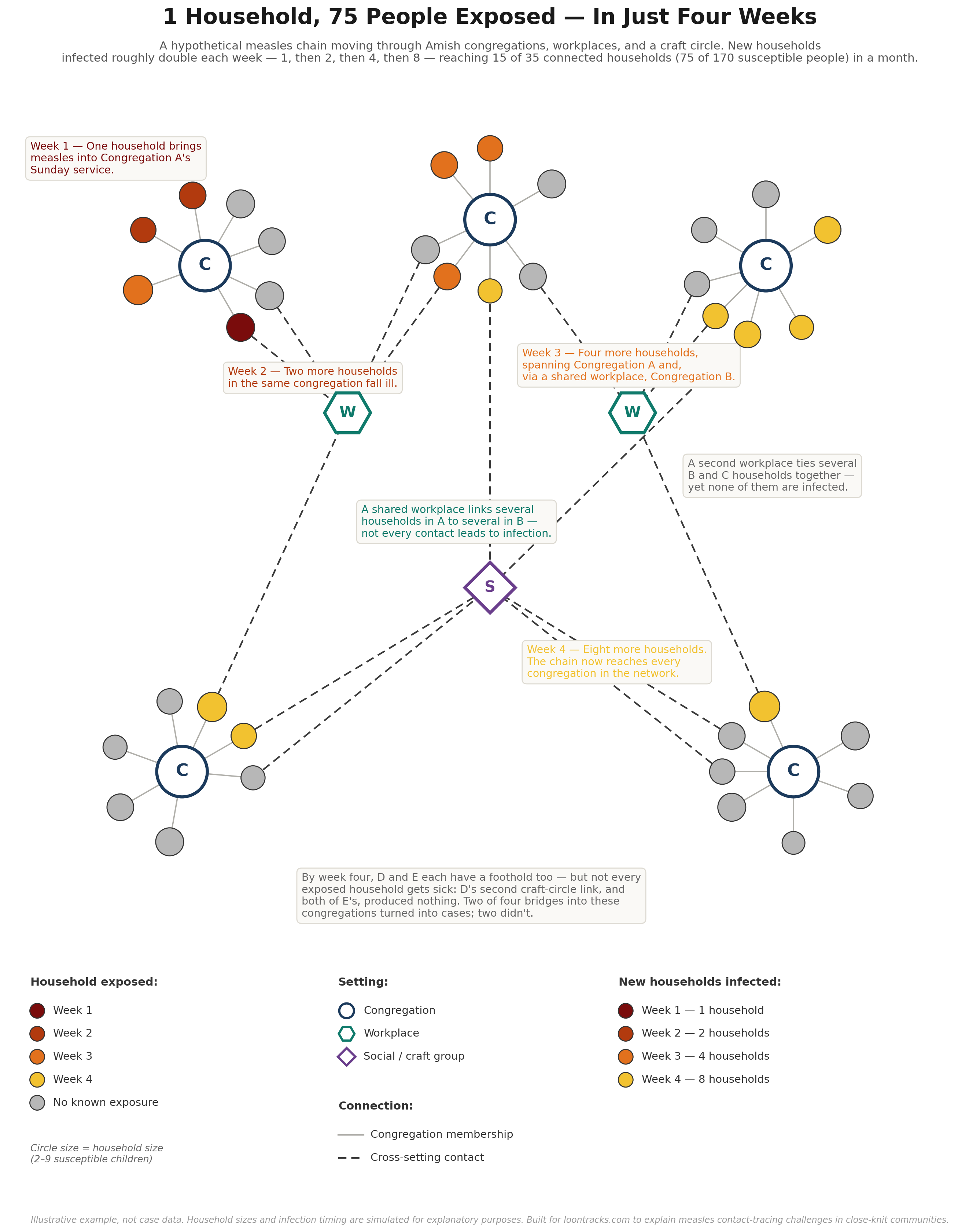
When several families, each with a large number of children who have never been exposed to or vaccinated for measles come together for worship, there is an excellent opportunity for the virus to spread. Spread may be slowed, however, between congregations since workplace or social interactions are typically involve fewer individuals and fewer children.
This is why I think we could see lulls and jumps in measles cases in southwestern Wisconsin. There should be lulls as the virus works more slowly from one hub to another, but explode once it has been transmitted to a new hub and quickly spreads through that congregation.
These spokes and hubs carry across large geographic areas. Congregational interactions are more dependent upon shared practice or "Ordnung" than physical proximity. We may think all the Amish are the same, the Amish, however, do not share this perception.
Applied to the case at hand, the communities located in the area of the measles outbreak in Wisconsin share familial, business, and religious connections with the community many of their parents and grandparents grew up in: the Amish communities of Lancaster County, PA. That community it turns out, is the center of the largest current measles outbreak in the nation.
I’m going to continue to suggest that the evidence suggests the current outbreak in southwestern Wisconsin is rooted in the Amish community. Transmission has been slowed by the spoke and wheel nature of the community. Moreover, there is a fair probability that the original cases in Wisconsin followed a visit to or from the areas of Pennsylvania currently in the midst of their own measles wildfire.
All conjecture to be sure, but conjecture rooted in evidence.
What to expect next? I don’t really know. There has been little reporting of how successful vaccination techniques have been. Past outbreaks in Amish communities have revealed the challenges of contact tracing in those communities. Distrust of outsiders means that public health interventions depend upon trust between individuals rather than trust in the public health system. I don’t know what outreach has been done by local health agencies. I don’t know enough about the practices or culture of this Amish community to venture a guess how open they will be to public health interventions.
Good news, I was able to expand the measles case tracker on the website. Thanks to the good people at John Hopkins University, I can publish a national dashboard on a regular schedule rather than a regional data dependent upon when I am able to research news releases from a few states.
Theory Testing IRL & IRT
Let's use math to test a theory in real time.
The last two weeks appears to have witnessed an explosion of Measles cases in Southwestern Wisconsin. Except they did not explode, they just went unreported and unmeasured for a period of time before someone took notice. Once the alarm was sound, public health officials went into the field, and quickly found more cases.
This outbreak is unusual in another sense: it is earlier than expected. Historically, before we began to reap the benefit of the MMR vaccine, measles would stay dormant in the summer and then slowly build over the fall and winter as the school year and weather brought children (who lacked immunity from never having had the disease) together.

First a Theory
What does this pattern suggest? This looks like a close knit religious community with low vaccination rates had an outbreak and were dealing with it themselves, until such time as they could not.
Iowa county Wisconsin has a growing Amish population, and vaccination rates in Amish communities vary widely based upon local beliefs, leadership, and customs. This outbreak would fit a pattern.
Measles Outbreaks in Anabaptist Communities, 2013–Present
2013: Southern Alberta, Canada:Hutterite and Mennonite communities with 42 confirmed cases.
2014: Ohio, USA: Amish community with 383 confirmed cases across nine counties.
2024–2025: Southwestern Ontario, Canada: Mennonite community, traced to a New Brunswick gathering with over 177 confirmed cases.
2025: Gaines County, Texas, USA:Old Colony Mennonite community with over 762 confirmed cases and 3 deaths.
2025: Taber, Alberta, Canada: Low German Mennonite community and other low vaccination communities with over 2,000 cases.
My purpose is not to single out a particular community, I was a member of an Anabaptist community and I am very sympathetic to their goals and reading of Christian Scripture. My purpose is to show how we can apply math to what we know about a phenomenon to extrapolate evidence for what is not yet known. I won't lie; I would consider it a bonus if it highlighted the dangers of vaccine skepticism.
From Theory to Forecast (aka “Mathing the Math)
Measles has a reproduction number of 15. Vaccination rates do not change how effectively measles spreads, it reduces the population susceptible to infection. So, assuming the general population of 6 year olds in Wisconsin has a vaccination rate of .79 our adjusted R value is 15(1-.79)=3.15.
Estimates of vaccine rates among Amish communities vary widely, but let’s take the largest estimate I could find with a vaccination rate of .41 (but trending downwards). 15(1-.41)=8.85.
Measles can incubate for 7-21 days but the generally accepted average is 12 days for each new generation of infections. So it find k for each community we take ln(R)/days. Our general population comes out at k=.09562. The Amish community would have a value of k=.1817.
So our exponential growth functions look like this:
General Population: (n)e^.09562t
Amish Community: (n)e^.1817t
Two Forecasts
If the measles outbreak is focused in the Amish Community and social distancing measures were not undertaken the moment the infection went public, we would expect to see cases rise to ~125 in the next seven days. This number could be larger if we over-estimated the vaccine rate in the Amish community or the current number of cases continues to be understated.
If the cases are centered in the General Community, that number should be significantly lower, ~68 or less, given that school has yet to begin in the general population and we live less social lives and have smaller families with fewer children than our Amish neighbors.
If the cases are somewhere in-between, we would be led to believe that the infection is spreading in both communities.
Measles outbreaks strain medical resources in the area impacted, created unnecessary suffering for the individuals infected, and result in needless deaths. These facts are not in dispute. This is real life, it is not a math game. But we can use math to test theories. We can use it to discern details of a narrative that are not reported in the news media. It can help confirm or deny a hypothesis.
With another week’s of reporting, we should be able to discern if this outbreak is concentrated in one community or the other. Let’s find out.
Addendum:
The math also works backwards. With the 35 known cases we can estimate ln(35)/.1817 that if the infection is in the Amish community, the first person would have been infectious around July 22, 2026. If it was in the general community, (ln(35)/.09562) the first person would have been infectious around July 5, 2026. I would posit it is more likely that the measles infection worked its way through an Amish Community for 11 days without be noticed than existing in the general community for 28 days without being reported.
60 days clean
I have long found the large internet content providers distasteful, ugly, and damaging to the culture. But I find a lot of things about our 21st century experience distasteful, ugly, and damaging to those of us living in the present despite our unprecedented wealth and privilege, so I chose not to lose much sleep about it.
Then, however, came the second Trump administration and the sycophant behavior of these corporate giants. With age I have learned you can (and should) ignore most benign changes in physical appearance. One should not, however, ignore a growth which is cancerous. When these giants of social influence threw in their lot with the self-enriching, breaker of norms, the die was cast. I am against them and will do my part to not contribute to their influence or wealth.
Of course, it is not just me but I am confounded by those who claim to be infuriated by the social influence companies' courting of Trumpian favor while continuing to use the products which bring them wealth and power. Some judgment, yes, must be made. I still use Apple services and Microsoft products. Yet many who oppose the tech giants seem to feel disempowered to free themselves from the corporations they hold in disdain.
I’ve conducted three experiments, and came away with an impression of the challenges of each.

Quitting Amazon.com was easy. I only took a small hit in convenience and price. I think first world material consumption is a problem anyway, so I was glad to have motivation to change. Under the hood, however, I recognize that many of my projects may inadvertently make use of Amazon Web Services. That is a task for another day, but I am aware of it.
Quitting Meta was more difficult; it required the self-help skills of CBT and I often find myself using the language of twelve step programs to maintain my distance. While on vacation I made use of Snapchat for 24 hours to use the map feature with some family members. Even though it is not a part of Meta, I found myself staring at the app for minutes at a time resisting the temptation to add all these people I knew. It was challenging to delete the app after the need for its map function had passed. Quitting social media is analogous to quitting a drug, and relapse is real.
All of this was small change, however, to quitting Google. Alphabet products have so infiltrated our culture and our work that it is more akin to learning to live without an automobile than addiction or a consumer choice. It is wrapped in everything.
I still open Google products when work or my volunteer endeavors use it; I am not ready to cut myself off from joining with my community to do good work or earn a living. Just refusing to initiate projects with the services or feed the Google database of everything, however, has been challenging to say the least. It is right up there with my experiments in veganism and living without a car.
I am 90 days into the experiment and I have no intention of returning to these services. Quite the opposite, I am looking to make sure that I am really as free from their data-gathering vacuums as possible.
I still don’t know how to think about the experience of disempowerment I hear expressed by others. Yet I was surprised about how differently I experienced each of the three experiments. It was easy to give up Amazon, just switching from one store to many smaller venders with a trade off on price and delivery time. Giving up Meta’s social media platforms was like quitting a deeply ingrained bad habit like biting my nails or picking my nose in public. Google was the most difficulty and challenging. Not impossible, but it required rethinking my whole approach to my internet infrastructure. We should no feel disempowered, however, we just have to make a decision and then undertake the work to bring it to fruition.
Knowledge and Ignorance: the Path to Awe

We went out to Madeline Island, Wisconsin for a quick trip this past weekend to meet up with some friends, walk some beaches, hike some forest, and dip our toes in the water.
When we arrived, there was a good wind and rain was threatening. The physics of the natural world were making themselves evident, as vacationers left the beach for the shelter of their tents and campers. Waves crested and trees swayed as atmospheric pressure dropped and goosebumps formed on my skin from the cool humidity. I saw vectors and forces I can only pretend to begin to quantify.
I know just enough to see all the things I do not know. Knowledge, awareness of imy own ignorance, joy: this is how I would try to use prose to explain my experience of awe. In poetry we might say only that the landscaped crawled with “small gods."
Its not much different than visiting an art gallery, anyone can fall under the sway of the Dutch Masters or a Monet, but it hits at a different level when you begin to grasp the depth of the skill and detail involved. Knowledge provides the foundation of self-awareness and smallness. We all know the joy of burying ourselves in the sand of a beach in summer, but it is another thing altogether to experience awe that every atom heavier than hydrogen, including the silica between your toes, was born in a star that died eons before our sun was a swirling ball of gas.
Huron, my favorite Aussie/Collie mix, definitely understands joy; I see it on his face a dozen times a day. Awe, however, seems to be more uniquely human: I think of it as the place where joy, knowledge, and an acceptance of ignorance merge into one singular experience.
Like other human traits, it is one we can and should foster in ourselves and others.
Math, Presentation, and the Data DJ
There was never a doubt which two candidates would come out of the St. Louis County Commissioner District One primary with tickets to compete in the November General Election.
What was in question, is how they would be ranked by an engaged primary electorate. In full disclosure, while I mostly watched from the sideline, I had a solid choice in this race, the DFL endorsed challenger Kris Eilers.
I was privileged to join the primary night results watch party and organize the results as they were reported from the polls. With some GIS prep work the math-rich spreadsheet:

was transformed into fun visual for the hard-working volunteers who gathered for the party.

Add a projector hooked up to a laptop and bingo: a data DJ has arrived.
Applied math is just plain fun, at least for a small subset of us. Focus on a topic you care about, however, add a little computer science, and you can help make it fun for everyone in your community who nerds like you.