
Cases Doubled in One Week
A week ago I offered a way to discern the communities most impacted by the southwestern Wisconsin measles outbreak based upon the number of total cases we would see by the end of this week. I offered ~125 as a strong indicator of it being prevalent primarily in the local Amish community and ~68 if it were primarily located in the non-Amish community.
The number came in at 91, with additional suspected cases. Essentially right between my two test numbers, but I am going to suggest that my earlier “Amish indicator” was naive and the rate of infection I originally stated should have been lower. I also want to offer additional circumstantial evidence that the current outbreak is prevalent in the Amish community of southwestern Wisconsin.
Amish Society
The Amish are famous for their rejection of modern conveniences to foster a more community-focused way of life and faith. Most know that they reject automobile ownership for horse and human power for daily transportation. We do not always understand how that impacts their daily and weekly interaction (or how that would impact the spread of measles). If we imagine the Amish community around southwestern Wisconsin graphically we might sketch something like this:
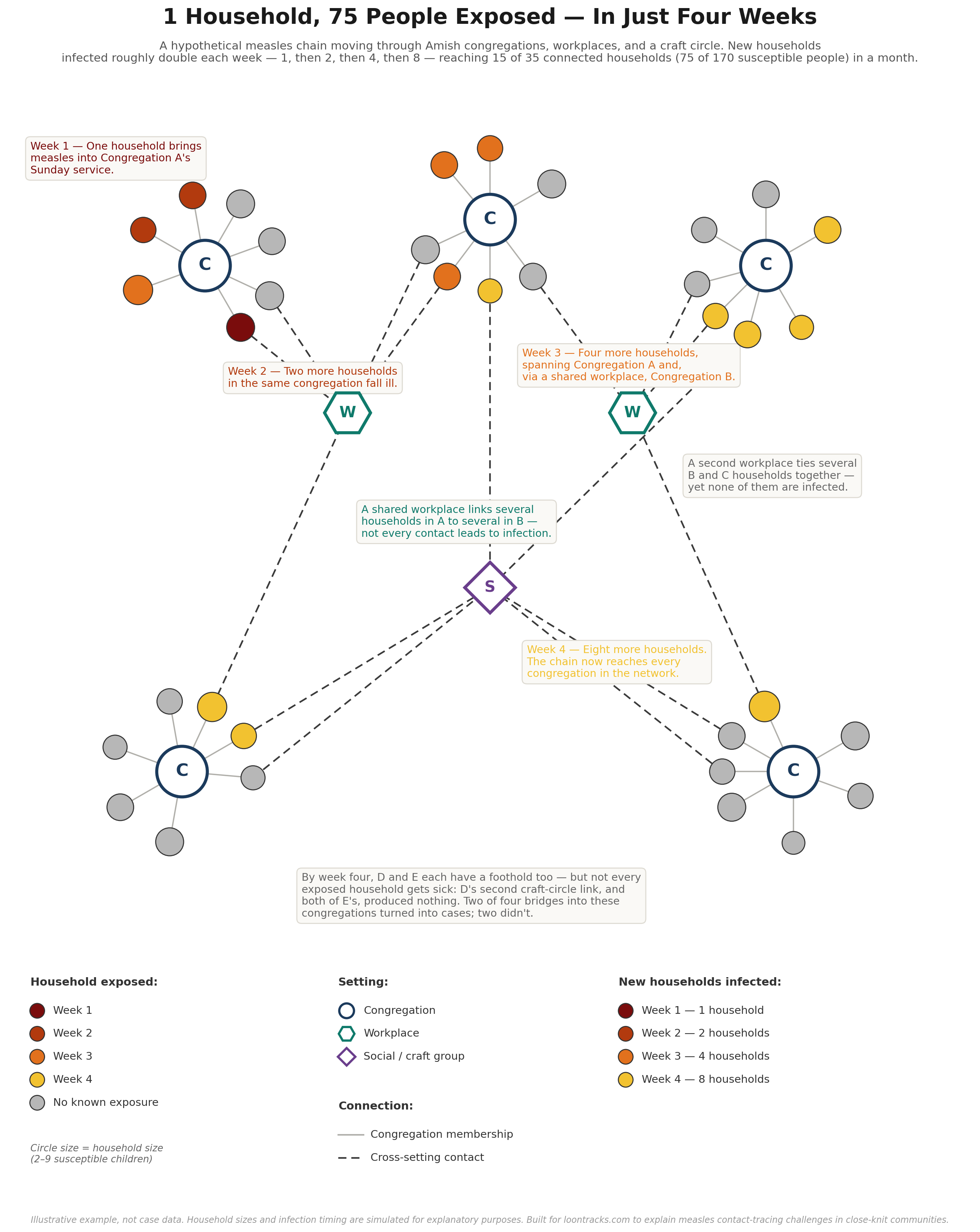
When several families, each with a large number of children who have never been exposed to or vaccinated for measles come together for worship, there is an excellent opportunity for the virus to spread. Spread may be slowed, however, between congregations since workplace or social interactions are typically involve fewer individuals and fewer children.
This is why I think we could see lulls and jumps in measles cases in southwestern Wisconsin. There should be lulls as the virus works more slowly from one hub to another, but explode once it has been transmitted to a new hub and quickly spreads through that congregation.
These spokes and hubs carry across large geographic areas. Congregational interactions are more dependent upon shared practice or "Ordnung" than physical proximity. We may think all the Amish are the same, the Amish, however, do not share this perception.
Applied to the case at hand, the communities located in the area of the measles outbreak in Wisconsin share familial, business, and religious connections with the community many of their parents and grandparents grew up in: the Amish communities of Lancaster County, PA. That community it turns out, is the center of the largest current measles outbreak in the nation.
I’m going to continue to suggest that the evidence suggests the current outbreak in southwestern Wisconsin is rooted in the Amish community. Transmission has been slowed by the spoke and wheel nature of the community. Moreover, there is a fair probability that the original cases in Wisconsin followed a visit to or from the areas of Pennsylvania currently in the midst of their own measles wildfire.
All conjecture to be sure, but conjecture rooted in evidence.
What to expect next? I don’t really know. There has been little reporting of how successful vaccination techniques have been. Past outbreaks in Amish communities have revealed the challenges of contact tracing in those communities. Distrust of outsiders means that public health interventions depend upon trust between individuals rather than trust in the public health system. I don’t know what outreach has been done by local health agencies. I don’t know enough about the practices or culture of this Amish community to venture a guess how open they will be to public health interventions.
Good news, I was able to expand the measles case tracker on the website. Thanks to the good people at John Hopkins University, I can publish a national dashboard on a regular schedule rather than a regional data dependent upon when I am able to research news releases from a few states.